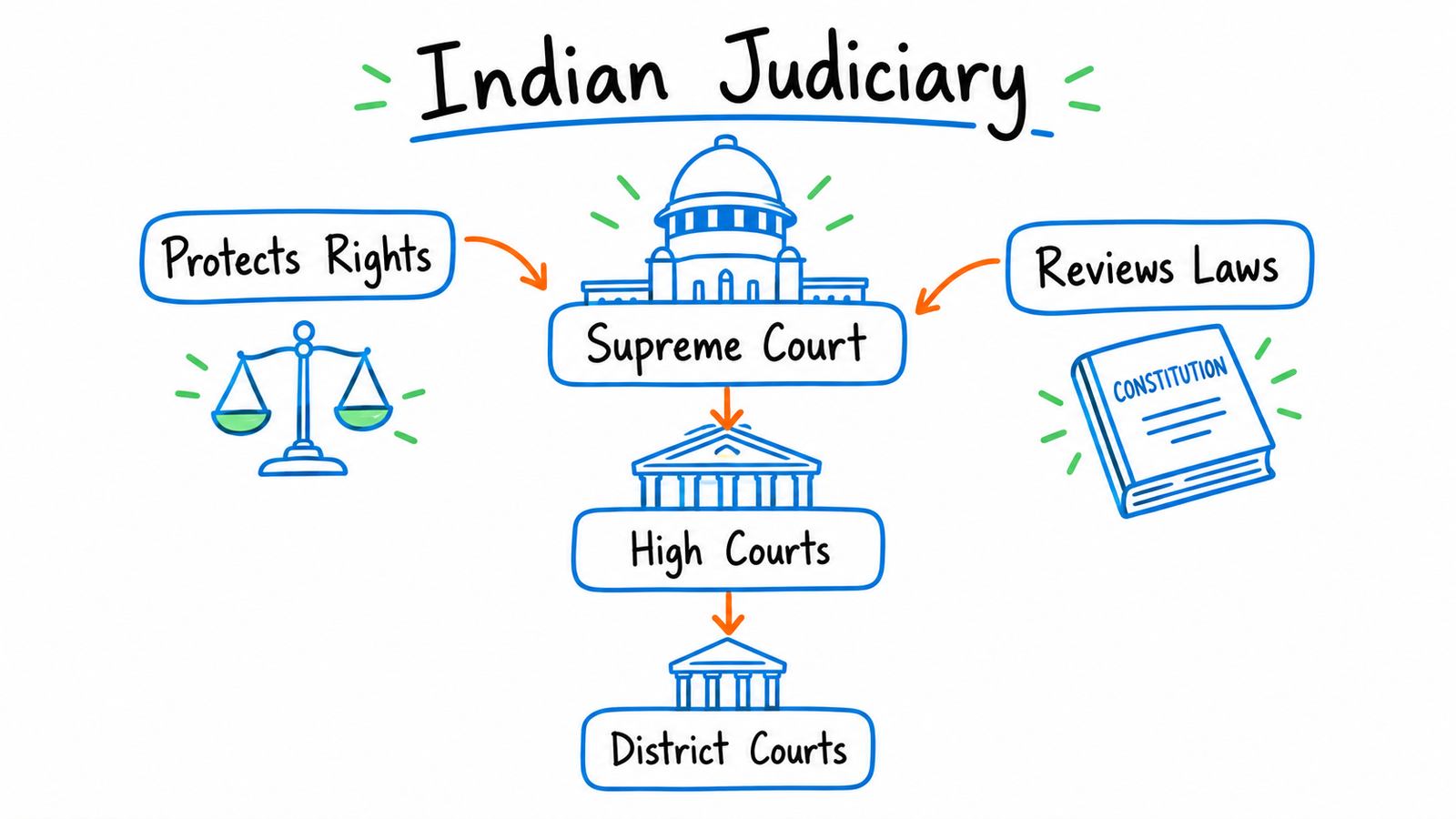
Indian Judiciary is the independent judicial system that interprets the Constitution, protects Fundamental Rights, settles disputes and reviews the legality of government action. India follows an integrated judicial structure headed by the Supreme Court, followed by High Courts and subordinate courts.
In one sentence: The Indian Judiciary protects constitutional supremacy and the rule of law by ensuring that every public authority acts within the Constitution.
What is the Indian Judiciary?
The judiciary is one of the three principal organs of the Indian State, alongside the legislature and the executive. Its primary function is to administer justice. It interprets laws, resolves civil and criminal disputes, safeguards individual rights and checks unconstitutional action by the government.
Unlike a completely separate federal court system, India has a broadly integrated hierarchy of courts. Decisions of the Supreme Court are binding on all courts within India under Article 141.
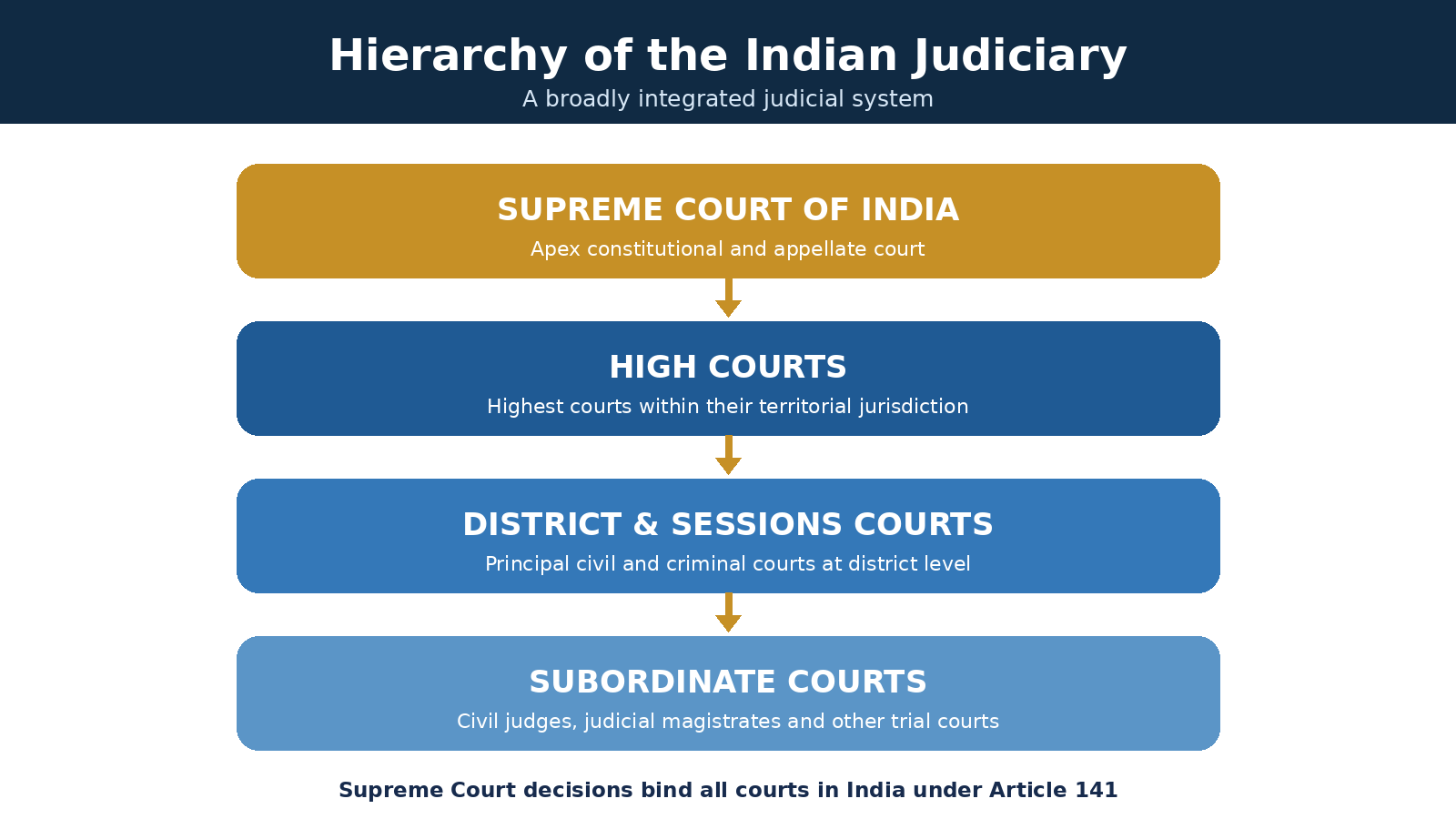
Structure of the Indian Judicial System
| Level | Main institution | Constitutional provisions | Primary role |
|---|---|---|---|
| National | Supreme Court of India | Articles 124–147 | Final constitutional and appellate court |
| State | High Courts | Articles 214–231 | Highest court within a state or group of states/Union Territories |
| District | District and Sessions Courts | Articles 233–237 | Major civil and criminal cases at district level |
| Local | Subordinate civil and criminal courts | State laws and procedural laws | Trial and local-level adjudication |
Supreme Court of India
The Supreme Court is the apex court and the final interpreter of the Constitution. Article 124 provides for its establishment and constitution. Its judgments bind every court in India.
Major jurisdictions of the Supreme Court
- Original jurisdiction — Article 131: Certain disputes between the Union and states, or among states, may begin directly in the Supreme Court.
- Writ jurisdiction — Article 32: It may issue writs to enforce Fundamental Rights.
- Appellate jurisdiction — Articles 132–136: It hears constitutional, civil and criminal appeals and may grant special leave to appeal.
- Advisory jurisdiction — Article 143: The President may seek its opinion on questions of law or fact of public importance.
- Review jurisdiction — Article 137: It may review its own judgments or orders.
- Court of record — Article 129: Its records have evidentiary value, and it can punish for contempt.
High Courts
Article 214 provides for a High Court for each state, although Parliament may establish a common High Court for two or more states or for states and Union Territories. A High Court supervises the courts and tribunals within its territorial jurisdiction.
Important powers of a High Court
- Writ jurisdiction — Article 226: A High Court may issue writs for Fundamental Rights as well as for other legal rights. This jurisdiction is wider in scope than Article 32.
- Superintendence — Article 227: It supervises courts and tribunals within its territory, subject to constitutional limitations.
- Court of record — Article 215: It can preserve authoritative records and punish for contempt.
- Control over subordinate courts — Article 235: It exercises administrative control over the subordinate judiciary.
Subordinate Judiciary
Subordinate courts operate below the High Courts. At the district level, the District Judge generally handles civil matters, while the Sessions Judge deals with serious criminal cases. The same judicial officer may function in both capacities.
Below the district level are civil judges, judicial magistrates and other courts created under relevant laws. Articles 233 to 237 deal with the subordinate judiciary, including appointments and administrative control.
How is Judicial Independence Protected?
Judicial independence means that judges must decide cases without improper pressure from the legislature, executive, private interests or public opinion. The Constitution supports this independence through several safeguards:
- Security of tenure for constitutional court judges
- A difficult removal procedure based on proved misbehaviour or incapacity
- Salaries and administrative expenses charged on the relevant Consolidated Fund
- Restrictions on legislative discussion about judges’ conduct, except during a removal motion
- Power to punish for contempt
- Separation of the judiciary from the executive under Article 50
- Constitutional protection of the jurisdiction and institutional authority of courts
Appointment and Removal of Judges
Appointment
Judges of the Supreme Court are formally appointed by the President under Article 124, while High Court judges are appointed under Article 217. In practice, recommendations are made through the collegium system developed through Supreme Court judgments.
Removal
A Supreme Court or High Court judge can be removed by the President only after each House of Parliament passes an address supported by the constitutionally required special majority, on the ground of proved misbehaviour or incapacity. This demanding process protects judges from arbitrary removal.
Judicial Review
Judicial review is the power of constitutional courts to examine whether laws and executive actions comply with the Constitution. If a measure violates the Constitution, the court may declare it invalid to the extent of the inconsistency.
This power flows from the constitutional scheme, including Articles 13, 32, 226 and other provisions defining the jurisdiction of the Supreme Court and High Courts. Judicial review is recognised as part of the Constitution’s basic structure.
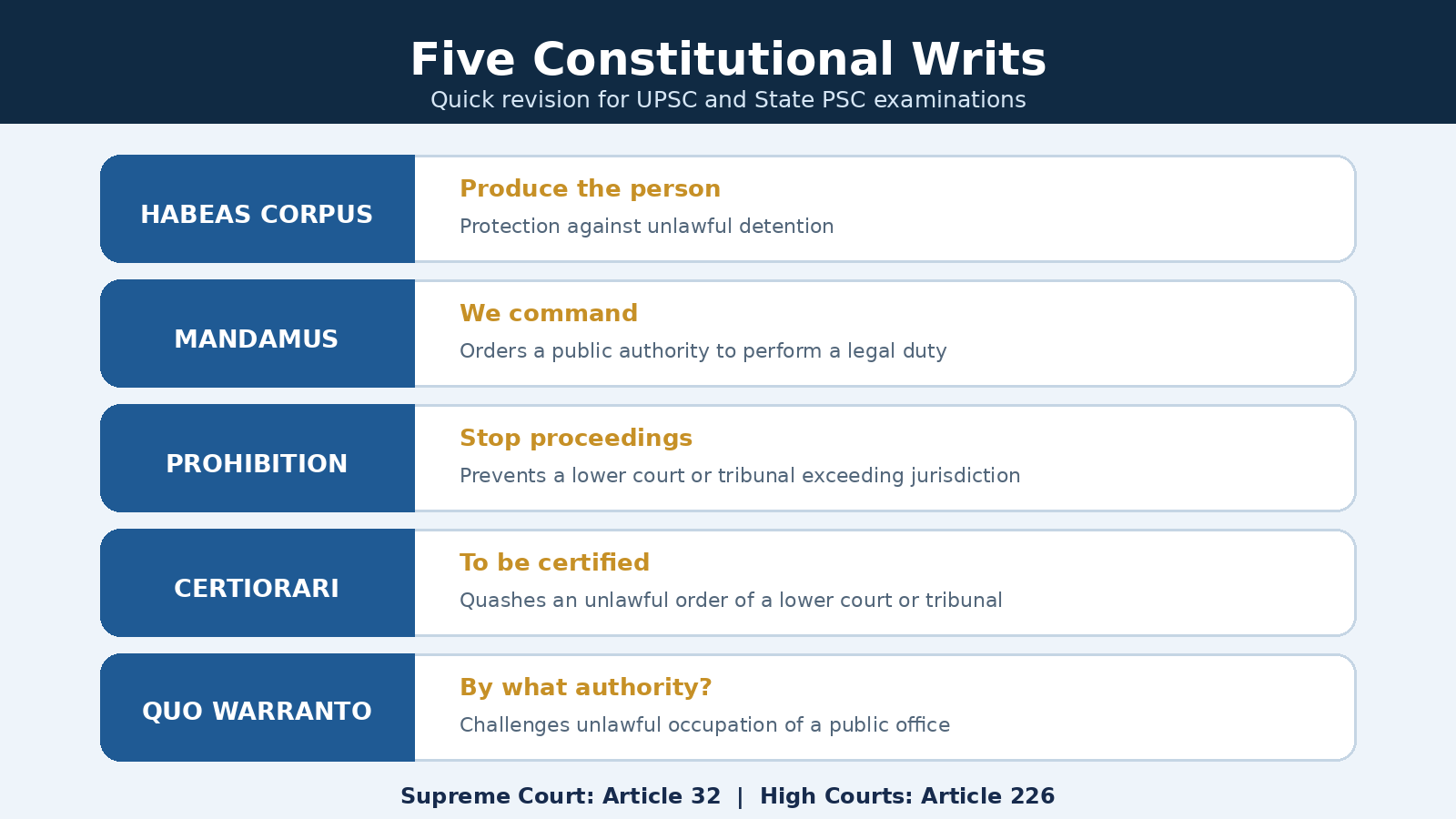
Five Constitutional Writs
| Writ | Simple meaning | Main purpose |
|---|---|---|
| Habeas Corpus | Produce the person | Protects against unlawful detention |
| Mandamus | We command | Directs a public authority to perform a legal duty |
| Prohibition | Stop proceedings | Prevents a lower court or tribunal from exceeding jurisdiction |
| Certiorari | To be certified/informed | Quashes an unlawful order of a lower court or tribunal |
| Quo Warranto | By what authority? | Challenges unlawful occupation of a public office |
Public Interest Litigation
Public Interest Litigation, or PIL, allows courts to hear matters affecting public interest, particularly where disadvantaged persons may be unable to approach the court themselves. PIL helped expand access to justice, but courts also discourage petitions filed for publicity, private disputes or political motives.
Judicial Activism and Judicial Restraint
- Judicial activism describes an active judicial role in protecting rights and addressing constitutional or administrative failures.
- Judicial restraint emphasises respect for the policy-making domain of elected institutions unless their action violates the Constitution or law.
A constitutional balance is necessary: courts must protect rights and legality while respecting the separation of powers.
Tribunals and the Judiciary
Tribunals are specialised adjudicatory bodies designed to decide particular categories of disputes. Articles 323A and 323B provide a constitutional framework for specified tribunals. Tribunal decisions remain subject to judicial review by constitutional courts.
Important Constitutional Articles on the Indian Judiciary
| Article | Subject |
|---|---|
| 32 | Constitutional remedies for enforcement of Fundamental Rights |
| 50 | Separation of judiciary from executive |
| 124 | Establishment and constitution of the Supreme Court |
| 129 | Supreme Court as a court of record |
| 131 | Original jurisdiction of the Supreme Court |
| 136 | Special leave to appeal |
| 137 | Review of Supreme Court judgments or orders |
| 141 | Law declared by Supreme Court binding on all courts |
| 143 | President’s power to consult the Supreme Court |
| 214 | High Courts for states |
| 215 | High Court as a court of record |
| 226 | High Court’s writ jurisdiction |
| 227 | High Court’s power of superintendence |
| 233–237 | Subordinate courts |
| 323A–323B | Tribunals |
Supreme Court vs High Court
| Point | Supreme Court | High Court |
|---|---|---|
| Position | Apex court of India | Highest court in its territorial jurisdiction |
| Writ provision | Article 32 | Article 226 |
| Purpose of writs | Enforcement of Fundamental Rights | Fundamental Rights and other legal rights |
| Binding authority | Its declared law binds all courts | Its rulings bind subordinate courts within its jurisdiction |
| Advisory role | May advise the President under Article 143 | No comparable constitutional advisory jurisdiction |
Why is the Indian Judiciary Important?
- Protects Fundamental Rights
- Preserves constitutional supremacy
- Maintains the rule of law
- Resolves Union–state and inter-state disputes
- Reviews legislative and executive action
- Provides remedies against unlawful detention and abuse of authority
- Maintains checks and balances among State institutions
Key Points for UPSC and State PSC Exams
- India has a broadly integrated judicial system with the Supreme Court at the apex.
- Article 32 itself is a Fundamental Right; Article 226 is broader because it covers other legal rights too.
- The Supreme Court is the final interpreter of the Constitution.
- Judicial review forms part of the basic structure of the Constitution.
- The collegium system is not expressly written in the Constitution; it evolved through judicial decisions.
- High Courts control the subordinate judiciary under Article 235.
- Article 50 is a Directive Principle concerning separation of the judiciary from the executive.
Indian Judiciary Previous Year Questions (PYQs)
The following judiciary questions are selected from MantraPrepp’s existing UPSC and State PSC PYQ collection.
1. PPSC PCS Prelims 2022 — Judicial Review
The concept of ‘Judicial Review’ in India has been borrowed from which country?
- United Kingdom
- USA
- Canada
- Australia
View answer and explanation
Correct answer: B — USA.
Judicial review allows constitutional courts to examine whether laws and government actions comply with the Constitution. In India, its constitutional basis includes Articles 13, 32 and 226.
2. BPSC Prelims 2022 — Constitutional Writs
Which writ is issued by a superior court to stop proceedings in an inferior court or tribunal?
- Mandamus
- Certiorari
- Prohibition
- Quo Warranto
View answer and explanation
Correct answer: C — Prohibition.
Prohibition is preventive: it stops a lower court or tribunal from continuing proceedings beyond its jurisdiction. Certiorari is generally corrective and quashes an unlawful order.
3. UPPSC PCS Prelims 2022 — Protection of Rights
Which Fundamental Rights cannot be suspended even during a National Emergency declared under Article 352?
- Article 19
- Articles 20 and 21
- Article 32
- Article 14
View answer and explanation
Correct answer: B — Articles 20 and 21.
Article 359 does not permit suspension of the right to move a court for enforcement of the protections guaranteed by Articles 20 and 21.
Study more Indian Polity previous year questions with explanations →
Frequently Asked Questions
What is the Indian Judiciary?
The Indian Judiciary is the system of courts that interprets laws, decides disputes, protects rights and ensures that government action conforms to the Constitution.
What are the three levels of courts in India?
The principal levels are the Supreme Court at the national level, High Courts at the state level, and district and subordinate courts at the local level.
Who is the guardian of the Constitution in India?
The Supreme Court is commonly described as the guardian and final interpreter of the Constitution, while High Courts also exercise important constitutional powers.
What is judicial review?
Judicial review is the power of courts to examine laws and government actions and invalidate them when they violate the Constitution.
Which Article is called the right to constitutional remedies?
Article 32 guarantees the right to approach the Supreme Court for enforcement of Fundamental Rights.
Why is Article 226 wider than Article 32?
Article 32 is primarily for enforcing Fundamental Rights. Article 226 allows High Courts to issue writs for Fundamental Rights and for other legal rights.
Is the collegium system mentioned in the Constitution?
No. The collegium system evolved through Supreme Court judgments interpreting the constitutional provisions governing judicial appointments.
Conclusion
The Indian Judiciary is central to constitutional governance. Through judicial review, writ jurisdiction and an integrated court structure, it protects rights, resolves disputes and ensures that institutions remain within constitutional limits. For competitive examinations, students should focus on the judicial hierarchy, major jurisdictions, constitutional articles, writs and safeguards of judicial independence.